Patrick Oconnell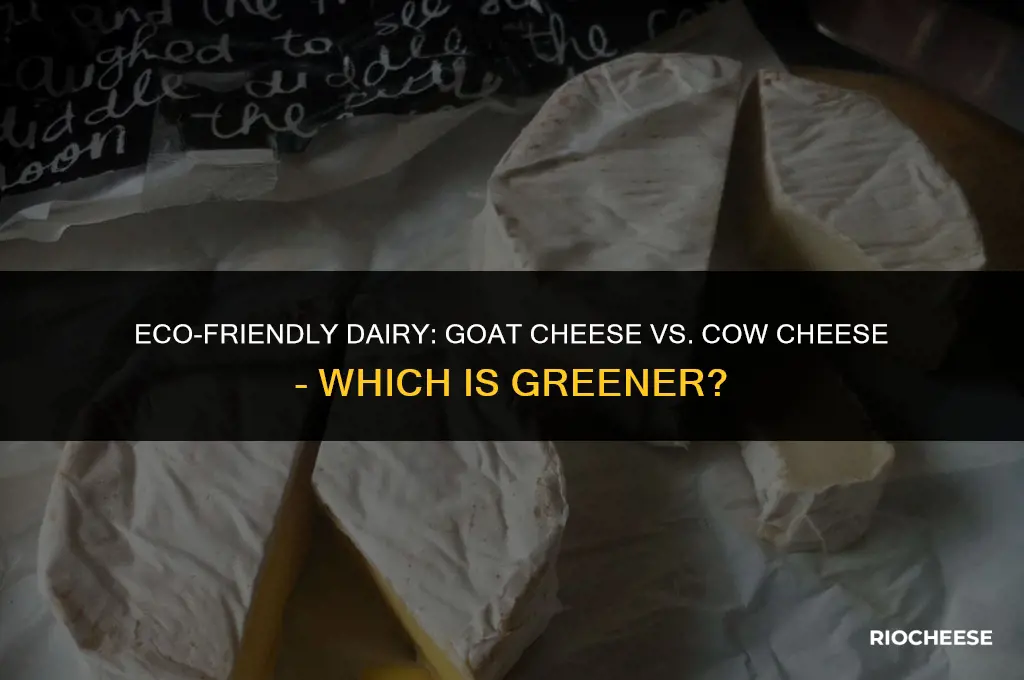
Goat cheese versus cow cheese: which is better for the environment? This question has sparked a lively debate among cheese enthusiasts and environmentalists alike. While both types of cheese have their own unique flavors and textures, their environmental impacts differ significantly. Goat cheese, often perceived as a more sustainable option, has a lower carbon footprint compared to cow cheese. This is primarily due to the fact that goats require less land, water, and feed to produce the same amount of milk as cows. Additionally, goat cheese production typically involves fewer additives and preservatives, making it a more natural choice. However, it's important to consider other factors such as the source of the milk, the cheese-making process, and transportation emissions when evaluating the overall environmental impact of these dairy products.
Explore related products


What You'll Learn
- Land Use Efficiency: Goats require less land for grazing compared to cows, potentially reducing deforestation and habitat destruction
- Water Consumption: Goats typically drink less water than cows, which could help conserve this vital resource
- Greenhouse Gas Emissions: The methane emissions from goats are generally lower than those from cows, contributing less to climate change
- Feed Requirements: Goats can thrive on a wider variety of plants, including those considered weeds, reducing the need for resource-intensive feed crops
- Waste Production: Goat manure is often considered a valuable fertilizer, while cow manure can be a significant source of pollution if not managed properly

Land Use Efficiency: Goats require less land for grazing compared to cows, potentially reducing deforestation and habitat destruction
Goats are known for their ability to thrive on marginal lands that are unsuitable for other livestock, such as steep slopes, rocky terrains, and areas with sparse vegetation. This adaptability means that goats require significantly less land for grazing compared to cows, which are typically raised on flat, fertile pastures. As a result, goat farming can help reduce the pressure on natural habitats and forests, which are often cleared to create grazing land for cattle. By utilizing land that would otherwise be considered unusable, goats can contribute to more efficient land use and help preserve biodiversity.
In addition to requiring less land, goats also have a lower impact on the soil compared to cows. Their hooves are smaller and less heavy, which reduces soil compaction and erosion. This is particularly important in areas with fragile ecosystems, where the introduction of large livestock can lead to significant environmental degradation. Furthermore, goats are browsers, meaning they eat a variety of plants, including shrubs and trees, which can help control invasive species and promote the growth of native vegetation.
The benefits of goat farming extend beyond land use efficiency. Goat cheese, which is the focus of this article, is often produced in smaller quantities and with less industrial processing compared to cow cheese. This can result in a lower carbon footprint and reduced energy consumption. Additionally, goat cheese is typically made from the milk of goats that are raised on pasture, which means they have access to fresh air, sunlight, and natural forage. This can lead to a healthier product for consumers and a more sustainable farming system overall.
However, it is important to note that goat farming is not without its challenges. Goats can be more difficult to manage than cows, requiring specialized knowledge and skills. They are also more susceptible to certain diseases and parasites, which can impact their health and productivity. Furthermore, the market for goat cheese is smaller than that for cow cheese, which can make it more difficult for goat farmers to earn a sustainable income.
Despite these challenges, the land use efficiency of goats makes them an attractive option for sustainable agriculture. By requiring less land and having a lower impact on the environment, goats can help reduce deforestation and habitat destruction, while also providing a nutritious and environmentally friendly source of dairy products. As consumers become more aware of the environmental impacts of their food choices, the demand for goat cheese is likely to increase, making goat farming a viable and sustainable option for farmers around the world.
Navigating Lactose Intolerance: The Truth About Goat Cheese
You may want to see also
Explore related products



Water Consumption: Goats typically drink less water than cows, which could help conserve this vital resource
Goats are known for their frugality when it comes to water consumption. Unlike cows, which can drink up to 30 gallons of water per day, goats typically require only about 1 to 2 gallons daily. This significant difference in water usage can have substantial implications for environmental conservation. By choosing goat cheese over cow cheese, consumers can indirectly support a reduction in water consumption, which is crucial in regions facing water scarcity.
The lower water consumption of goats can be attributed to their efficient digestive systems and their ability to extract moisture from the food they eat. Goats are browsers, feeding on shrubs, bushes, and trees, which often have higher water content compared to the grasses that cows graze on. This dietary difference means that goats can obtain much of the water they need from their food, reducing their reliance on additional water sources.
Furthermore, goats are better adapted to arid and semi-arid environments, where water is a limited resource. Their ability to thrive in these conditions without excessive water intake makes them a more sustainable choice for cheese production in regions where water conservation is a priority. In contrast, cows require more water not only for drinking but also for cooling down, especially in hot climates, which can further strain water resources.
In addition to the direct water savings, goat cheese production can also lead to indirect conservation benefits. Since goats require less water, the land used for their grazing can be more efficiently utilized, reducing the need for additional land clearing and the associated water usage for irrigation. This can help preserve natural habitats and biodiversity, which are essential for maintaining healthy ecosystems.
Overall, the lower water consumption of goats compared to cows presents a compelling argument for the environmental benefits of goat cheese. By supporting goat cheese production, consumers can contribute to water conservation efforts and promote more sustainable agricultural practices.
Can Cats Eat Goat Cheese? A Feline Nutrition Guide
You may want to see also
Explore related products


Greenhouse Gas Emissions: The methane emissions from goats are generally lower than those from cows, contributing less to climate change
Methane emissions from livestock are a significant contributor to greenhouse gas emissions, with cows being the primary source. However, goats emit considerably less methane than cows, making them a more environmentally friendly option for dairy production. This difference in emissions can be attributed to the unique digestive system of goats, which allows them to break down plant material more efficiently and produce less methane as a byproduct.
The lower methane emissions from goats can have a substantial impact on the environmental footprint of dairy farming. For instance, a study by the International Livestock Research Institute found that goats produce approximately 30% less methane than cows per unit of milk produced. This reduction in emissions can help mitigate the effects of climate change, as methane is a potent greenhouse gas with a global warming potential 25 times greater than carbon dioxide over a 100-year period.
In addition to their lower methane emissions, goats also have other environmental benefits compared to cows. Goats require less land and water to produce the same amount of milk, and they can graze on a wider variety of plants, including those that are considered weeds or invasive species. This can help reduce the need for chemical herbicides and promote biodiversity in pasture ecosystems.
However, it is important to note that the environmental impact of goat cheese production is not solely determined by methane emissions. Other factors, such as the source of feed, the use of antibiotics and hormones, and the transportation of products, can also contribute to the overall environmental footprint. Therefore, while goats may be a more environmentally friendly option than cows in terms of methane emissions, it is essential to consider the broader context when evaluating the sustainability of goat cheese production.
In conclusion, the lower methane emissions from goats compared to cows can make goat cheese a more environmentally friendly option for dairy consumers. However, it is crucial to consider the full range of environmental impacts associated with goat cheese production to make informed choices about its sustainability.
Goat Cheese vs. Goat Milk: Which One Reigns Supreme?
You may want to see also
Explore related products




Feed Requirements: Goats can thrive on a wider variety of plants, including those considered weeds, reducing the need for resource-intensive feed crops
Goats are known for their ability to consume a wide variety of plants, including those that are often considered weeds. This characteristic can significantly reduce the need for resource-intensive feed crops, making goat farming a more sustainable option compared to traditional livestock farming. By grazing on diverse vegetation, goats can help control invasive plant species and promote biodiversity in pastures.
One of the key benefits of goats' varied diet is their ability to thrive on plants that are not suitable for other livestock. This includes shrubs, trees, and various types of weeds that can be found in natural environments. As a result, goat farmers can utilize land that might otherwise be unsuitable for agriculture, reducing the pressure on arable land and minimizing the need for deforestation.
Furthermore, goats' efficient digestion allows them to extract nutrients from plants that are considered low-quality feed. This means that they can be fed with less processed and more locally sourced feed, reducing the environmental impact associated with transporting and processing feed crops. Additionally, goats produce less methane than cows, further contributing to their lower environmental footprint.
In terms of practical application, goat farmers can take advantage of this dietary flexibility by implementing rotational grazing systems. By moving goats to different pastures, farmers can ensure that the animals have access to a diverse range of plants while also preventing overgrazing. This approach can help maintain soil health, reduce erosion, and promote the growth of native plant species.
Overall, the ability of goats to thrive on a wide variety of plants, including weeds, offers significant environmental benefits. By reducing the need for resource-intensive feed crops and promoting sustainable land management practices, goat farming can contribute to a more eco-friendly food production system.
Exploring the Inflammatory Effects of Goat Cheese: A Comprehensive Guide
You may want to see also
Explore related products


Waste Production: Goat manure is often considered a valuable fertilizer, while cow manure can be a significant source of pollution if not managed properly
Goat manure is often considered a valuable fertilizer due to its high nutrient content and ability to improve soil health. Unlike cow manure, which can be a significant source of pollution if not managed properly, goat manure is typically lower in pathogens and can be used as a natural fertilizer without the need for extensive treatment. This makes goat cheese production a more environmentally friendly option compared to cow cheese production, as the waste generated from goats can be repurposed for agricultural use.
One of the main reasons why goat manure is considered a valuable fertilizer is its high nitrogen content. Nitrogen is an essential nutrient for plant growth, and goat manure provides a slow-release source of this nutrient, which can help to improve soil fertility over time. Additionally, goat manure is rich in other nutrients such as phosphorus and potassium, which are also important for plant growth. This makes goat manure a well-rounded fertilizer that can be used to support a variety of crops.
In contrast, cow manure can be a significant source of pollution if not managed properly. Cow manure contains high levels of pathogens and can contribute to water pollution if it is not properly stored or treated. Additionally, cow manure can produce methane, a potent greenhouse gas, during the decomposition process. This can contribute to climate change and other environmental issues.
To mitigate the environmental impact of cow manure, it is important to properly manage and treat the waste. This can involve composting the manure, which can help to reduce the levels of pathogens and methane production. Additionally, cow manure can be used as a fertilizer, but it is important to apply it in a way that minimizes the risk of water pollution.
Overall, the waste production associated with goat cheese production is generally considered to be more environmentally friendly than that of cow cheese production. Goat manure can be repurposed as a valuable fertilizer, while cow manure requires more careful management to avoid environmental pollution. This makes goat cheese a more sustainable option for those looking to reduce their environmental impact.
Navigating Dairy Choices: Is Goat Cheese a Good Option for Diabetics?
You may want to see also
Frequently asked questions
Goat cheese generally has a lower environmental impact than cow cheese. Goats require less land and water to produce the same amount of cheese, and they emit fewer greenhouse gases.
Goats are more efficient in converting feed into protein, require less land for grazing, and produce less methane, a potent greenhouse gas, compared to cows.
Yes, goat cheese production often involves less intensive farming practices, which can lead to better soil health and biodiversity. Additionally, goats can help manage invasive plant species, reducing the need for herbicides.
While goat cheese may be more environmentally friendly, it's important to consider other factors such as taste preferences, nutritional content, and local availability. Some people may not enjoy the taste or texture of goat cheese, and it may not be as widely available in all regions.